The short answer
- In short
- A software wallet is an app on a phone or computer that is usually online, which is why people call it a hot wallet. A hardware wallet is a small device that keeps your keys offline, a form of cold storage.
- The catch
- Neither one helps if the recovery phrase leaks or gets lost. The backup matters more than the device.
- Depends on you
- Small amounts you spend or trade often sit comfortably in a software wallet. Savings you rarely touch are the usual case for a hardware wallet.
What a crypto wallet actually holds
A wallet does not store coins the way a purse stores cash. Your crypto lives on a blockchain, and the wallet holds the private keys that let you move it. Whoever has the keys can spend the funds, and nobody can reverse that for you.
That is the reason the hardware versus software question exists at all. It is a question about where your keys live and what can reach them.
Both kinds covered here are wallets, which means you hold the keys yourself. Leaving coins in an exchange account is a different arrangement, because there the company holds them for you.
Hot wallet vs cold wallet is the same question in other words
You will see “hot” and “cold” used as often as “software” and “hardware”. Hot means the keys sit on a device that connects to the internet. Cold means they are kept offline.
In everyday use the pairs line up. Software wallets are hot and hardware wallets are cold. There are edge cases, such as a software wallet on a computer that never goes online, but they are rare enough that you can treat the terms as twins.
Software wallets are convenient and always nearby
A software wallet is an app or a browser extension. Setting one up takes minutes and usually costs nothing, and it is ready whenever your phone is. For paying, swapping or connecting to apps, that convenience is hard to beat.
The trade-off is exposure. The keys sit on a device that also runs your email, your browser and whatever you installed last week. Malware, a fake app or a convincing phishing page can reach a software wallet in ways they cannot reach a device that stays offline.
Where a software wallet fits
- Amounts you would be annoyed, but not ruined, to lose
- Frequent payments, swaps or app use
- Learning how sending and receiving work before you buy a device
What is a hardware wallet, and what does it protect?
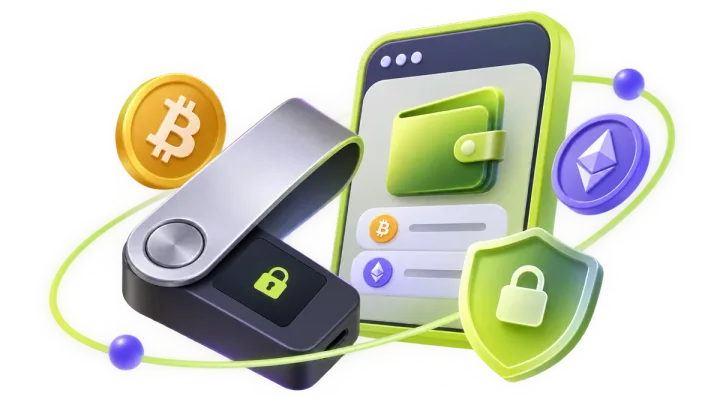
A hardware wallet is a dedicated device, often about the size of a USB stick. It creates and stores your keys internally and signs transactions inside the device, so the keys never pass through your computer or phone. You confirm each transaction on the device itself, with a button or a touchscreen.
This blocks the usual remote attacks. Someone who compromises your laptop still cannot move funds without the physical device and its PIN.
It has costs of its own. You pay for the device, sending takes a few more steps, and you still have to read the address on its screen. The device will faithfully sign a payment to a scammer if you approve it.
A device that arrives already set up, or with a recovery phrase printed in the box, has been tampered with. A genuine wallet generates the phrase in front of you during setup.
Hardware vs software wallet, side by side
| Software wallet | Hardware wallet | |
|---|---|---|
| Where the keys live | On your phone or computer | Inside a separate device, offline |
| Cost | Usually free | A one-off purchase |
| Speed of use | Seconds | A minute or two, device in hand |
| Main risk | Malware and phishing on the same device | Losing the backup, or approving a bad transaction |
| If the device is lost | Restore with the recovery phrase | Restore with the recovery phrase |
How to choose between them
Start with two questions. How much would it hurt to lose what is in the wallet? And how often do you need to move it?
Money you use every week belongs somewhere quick. Money you are holding for years gains little from being one tap away and loses a lot from being exposed. Plenty of people end up with both, a software wallet for spending and a hardware wallet for the rest, the way you might carry some cash and keep your savings elsewhere.
There is no fixed amount at which a hardware wallet becomes worth buying. A useful test is to set the price of the device against the sum it would protect, and to picture the morning after losing that sum.
The backup matters more than the device
Every wallet of either kind gives you a when you set it up, usually 12 or 24 words. Those words are your keys in a readable form. With them you can rebuild the wallet on a new device. So can anyone else who sees them.
Many losses start here. People photograph the phrase, save it in a notes app, or type it into a website that claims to be support. A hardware wallet cannot help once the phrase is out.
What is a hardware wallet?
A dedicated device that stores your private keys offline and signs transactions internally. You confirm each transaction on the device, so the keys never touch your computer or phone.
Read more: What is a hardware wallet, and what does it protect?Copy link
Is a hardware wallet safer than a software wallet?
Against remote attacks, yes. The keys stay offline and each transaction needs a physical confirmation. It does not protect a leaked recovery phrase or a payment you approve by mistake.
Read more: What is a hardware wallet, and what does it protect?Copy link
Is a hot wallet the same as a software wallet?
In everyday use, yes. Hot means the keys are on an internet-connected device, which describes almost every software wallet. Cold means the keys are kept offline, as in a hardware wallet.
Read more: Hot wallet vs cold wallet is the same question in other wordsCopy link
What happens if I lose my hardware wallet?
Your crypto is not inside the device. You can restore the wallet on a new device with the recovery phrase. Without the phrase, the funds cannot be recovered.
Do I need a hardware wallet for a small amount?
Not necessarily. For sums you would not be seriously hurt to lose, a software wallet with a well-protected recovery phrase is a reasonable choice.
How we research · Educational content, not investment advice. Cryptoassets are high risk and you could lose all the money you invest. Rules and availability vary by country.